Art Deco gems from every province

Below is a selection of more than 25 well-known and lesser-known Art Deco buildings located in both major cities and small communities from each province in Canada.

Clicking on each image opens a webpage that recounts the building’s history, and describes and illustrates its distinctive architectural features.

BRITISH COLUMBIA

Marine Building overall
Marine Building, Vancouver, 1929–30
The Kelowna Post Office, opened in 1937, was was a remarkably original example of Art Deco. Sadly, it was demolished in late 1971 or 1972.
Kelowna Post Office, 1937 (demolished)
Finished with lightly textured white stucco, the Second G.D. Loane House from 1937 is an outstanding example of the Streamlined Moderne style,
Second G.D. Loane House, Kelowna, 1937
The Vogue Theatre, 1940, remains a stellar example of Art Deco design.
Vogue Theatre, Vancouver, 1940

ALBERTA

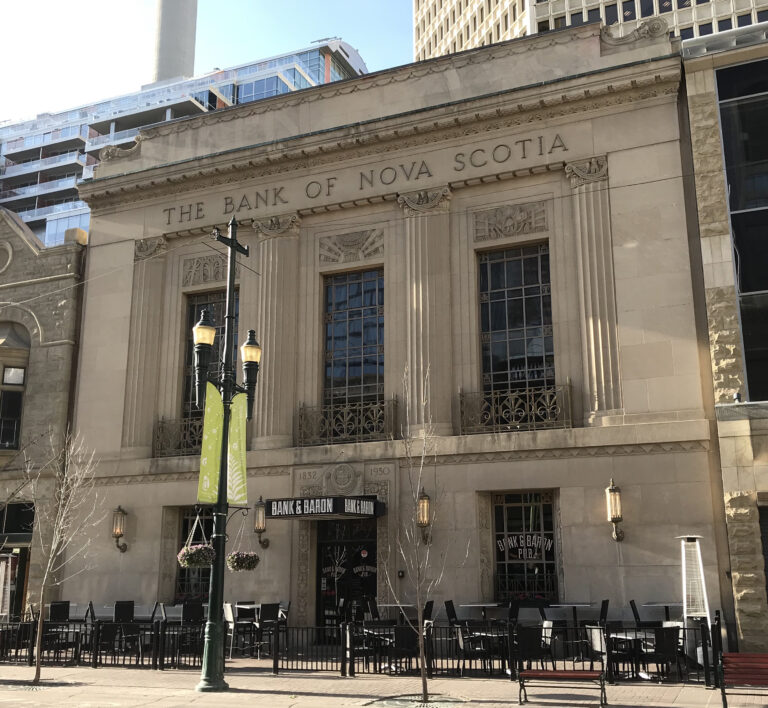
The bank's façade is a fine example of Stripped Classical styling.
Bank of Nova Scotia, Calgary, 1930
Alexandra Hotel Tavern, Drumheller, 1938
The theatre’s façade, seen here in 2016, is dominated by a stucco-clad, step-back pylon.
Garneau Theatre, Edmonton, 1940

SASKATCHEWAN

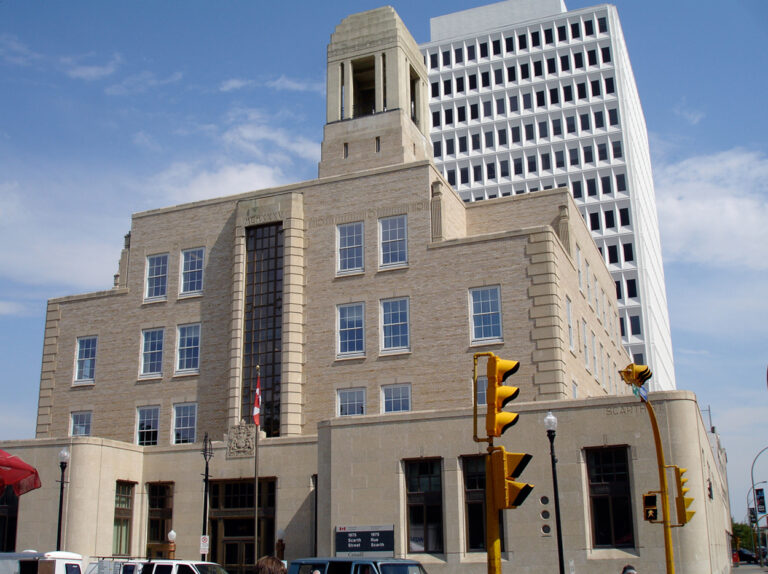
Seen here in 2012, the distinctive 1935 Federal Building is primarily Stripped Classical in style.
Federal Building, Regina, 1935
Photo of present-day Wadena Town Hall.
Wadena Post Office, Wadena, 1938

MANITOBA

Overall view of the main façade.
Women's Tribute Memorial Lodge, Winnipeg, 1930–31
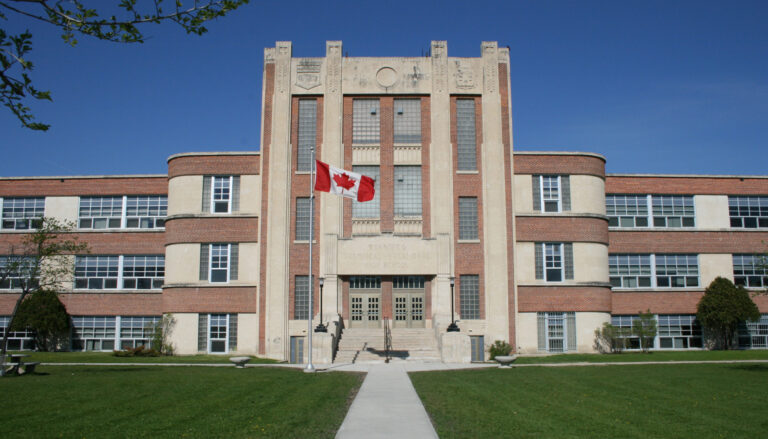
Main (eastern) facade.
Winnipeg Technical-Vocational High School, 1949–1951

ONTARIO

In this 2017 photo of the front (Carlton Street) façade, the original canopy has been faithfully reproduced.
Maple Leaf Gardens, Toronto, 1931
Southwest view of Eaton’s College Street Store (now College Park), from 1990s.
Eaton's College Street Store, Toronto, 1919–30
The building had been vacated when this photo was taken in 1990; notice the ‘S’ missing from Timmins.
Timmins Daily Press, 1939-40 (demolished)
The rounded-corner streamlined balconies on the three-storey block facing Bayview frame a tall glass-block window that illuminates the stairwell behind. Notice the horizontally proportioned panes of glass in the metal-sash casement windows, and the protruding brick stripes marking the corner.
Garden Court Apartments, Toronto, 1938-42

QUEBEC

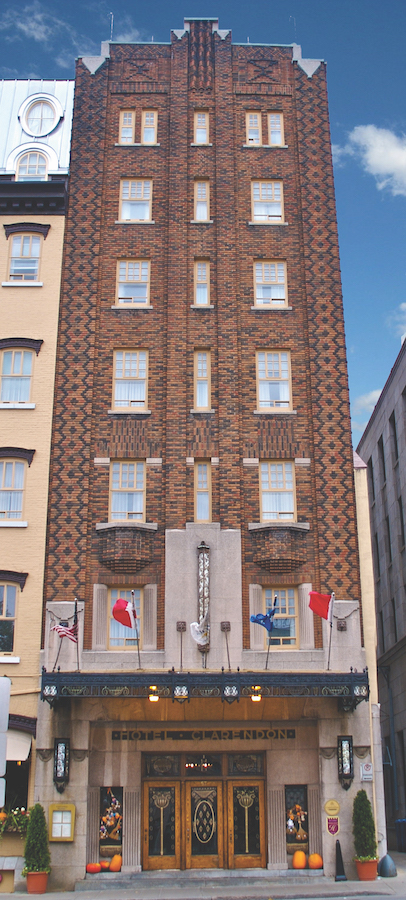
Clarendon Hotel, Quebec City, 1927
In this street level view, the building towers over its neighbours, including the Clarendon Hotel in the foreground.
Price Building, Quebec City, 1929–1931
The north-facing front façade consists of two distinct blocks, the taller of which is dominated by the large studio window. Atop the window are three decorative vertical bands, adorned with floral motifs; below is a heavy stone planter with carved bunches of grapes. Notice how the window’s horizontal mullions are aligned with the wall’s mortar joints to create an uninterrupted lateral effect that contrasts with the series of subtle vertical planes flanking the opening.
Cormier House, Montreal, 1930–31
Although the church has a Latin cross floor plan and displays massing more reflective of conventional Gothic Revival styling, it possesses a number of Zigzag features, including the flattened treatment of its decorative details.
Ste. Philomena of Rosemont Church, Montreal, 1932-33

NEW BRUNSWICK

Town Hall’s styling is predominantly Stripped Classical, with some Zigzag elements.
Ste. Philomena of Rosemont Church, Montreal, 1932-33
Robbins Drug Store's Streamlined Moderne facade.
Robbins Drug Store, Saint John, 1939 (demolished)

NOVA SCOTIA

The building seen in 2005, during its ‘Discovery Centre’ phase (after Zellers had moved elsewhere).
Zeller’s Department Store, Halifax, 1938–39
Main (southeast) façade of the library, seen in 2011.
Halifax Memorial Library, 1949-51

PRINCE EDWARD ISLAND

1994 view of the Peardon building.
Peardon Building, Charlottetown, 1930

NEWFOUNDLAND & LABRADOR

The front façade, seen here in 1994 while the CBC still occupied the building.
Total Abstinence Society Building, St. John’s, late 1940s
Overall view of the Streamlined Moderne-styled house. Photos: Robert Mellin.
Smith Residence, Corner Brook, 1950