With the opening of the Panama Canal in 1914, Vancouver quickly became an important port for shipments to Europe. Thanks to the foresight of Captain J.W. Hobbs – together with financing arranged by Toronto bond house G.A. Stimson and Co. – the Marine Building was intended to be the city’s most prestigious office building, bringing grain and lumber shipping companies, insurance brokers, and import / export merchants together under one roof.
Situated in the heart of the business district and adjacent to the waterfront, the 20-storey building was designed by the Vancouver architecture firm McCarter & Nairne. Construction began in 1929 and lasted 16 months; the cost to complete the structure was $2.3 million – $1.1 million over budget. Beyond offices, the tower included a luxuriously furnished penthouse apartment, complete with a living room that offered stunning views of the harbour and surrounding downtown.
The Marine Building dominated downtown Vancouver’s skyline in 1931.
The ‘most modern office building in Western Canada’ According to its original promotional brochure, the Marine Building “is the largest, highest and most modern office building in Western Canada, and is only exceeded by one or two buildings in the Empire.”
The onset of the Depression meant that much of the tower lay vacant. The City of Vancouver declined an offer to purchase it for a million dollars to use as a city hall. Eventually, the Marine Building was sold in 1933 for just $900,000 to Vancouver entrepreneur Fred Taylor, with financial backing from Ireland’s Guinness family (of beer fame).
Today, after several careful renovations and mechanical upgrades, the Marine Building continues to be a sought-after office location, and is home to several restaurants on the ground floor. It has appeared in several films and television programs, including the long-running series Smallville, in which it was the headquarters for Clark Kent’s Daily Planet newspaper.
The architecture
The Vancouver Sun’s opening-day supplement quoted the architect’s description that the tower “suggests some great marine rock rising from the sea, clinging with sea flora and fauna, tinted in sea green, flashed with gold, at night a dim silhouette piercing the sea mists.”
The facade The building’s brown brick walls are accented by decorative terracotta situated at key locations, including the front entrance, above the lower floors, and the cornice of each step-back. This extraordinary marine- and technology-themed decoration – created by ‘Doc’ Watson, C. Young, and J.D. Hunter at McCarter & Nairne – arguably makes the Marine Building Canada’s best Art Deco skyscraper.
The building is ‘textbook’ example of Zigzag, with step-back massing, windows in vertical bands, and a two-storey entrance.
Terracotta seahorses, geese, and leaping fish embellish the fourth-storey cornice of the angled base of the building.
The front entrance Marine-themed terracotta decoration, including underwater plants and crayfish, literally surrounds the two-storey recessed entrance. The multi-coloured screen above the revolving wooden doors features a sunburst with Captain Vancouver’s ship at the centre, in front of which fly six stylized Canada Geese, which were once covered in gold leaf.
Marine-themed terracotta decoration literally surrounds the two-storey recessed entrance.
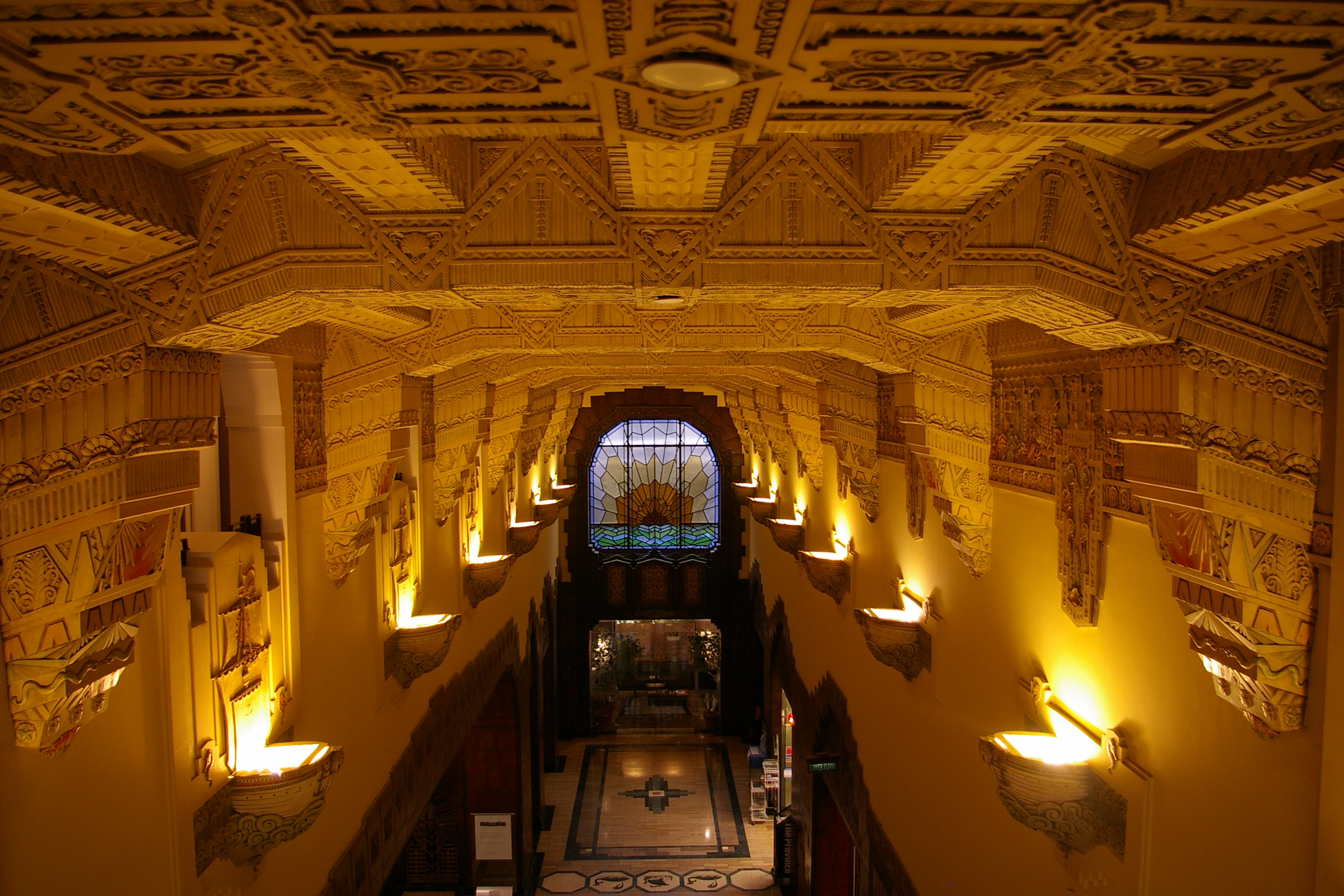
The interior The flood of decoration continues inside the two-storey lobby, whose ornately bracketed ceiling is illuminated by sconce lights hidden behind protruding ship prows. The original lobby floor, featuring battleship linoleum from Scotland, has been replaced by a terrazzo floor with large astrological symbols, but the metal elevator doors bearing bas-relief marine motifs are still intact.
The double-height foyer, seen here from the mezzanine, boasts colourfully decorated upper walls and an ornate ceiling.
Additional examples of this remarkable decoration can be found in the Canadian Art Deco architectural decoration of the website.
Archival photo credit: Photo taken from the2nd Hotel Vancouver by J. Fred Spalding, City of Vancouver Archives #371-1157.